Showing posts with label Ramallah. Show all posts

Wednesday, 11 March 2015

Inside Israel's Military Courts - visiting Ofer

Ofer - UN photograph
According to Addameer Association, there are currently 6200 Palestinian political prisoners.  Every person I have met during my short time in the West Bank has a friend or relative who has been imprisoned, often under 'administrative detention' meaning they have not been charged or tried.    Any opposition to the occupation is deemed a 'threat' to the security of Israel. Perhaps it is this alleged 'threat' that Israel feels justifies their continued human rights abuses of prisoners.

This week, I attended a trial of my friend Mohammad Alazza in 'Ofer' Israeli military court, which lies within the Ofer prison grounds on the outskirts of Ramallah.  I wasn't convinced I would be permitted entry however on reflection it is obvious that Israel's international impunity which has allowed the occupation and land theft to continue, means they no longer care who knows  the ins and outs of their mickey mouse judicial system.

Despite its close proximity to bustling Ramallah, it is an eerily quiet place.  It was 27 degrees and court attendees have to park some distance away, walking along a dusty track to pass their first security check.  A young Israeli woman looked at my passport and sent us through the metal turnstiles.  Like many of the soldiers/security staff I met, she spoke neither Arabic nor English, making the process even more confusing and obscure.  We then walked a much further distance, passing a manned watch tower, the occupying army flag flying high in the air.  

We arrived to the 'waiting room' which is effectively an over-sized bus shelter with rusty chairs and a few lockers where you should leave all your belongs and pay 5 shekels for the privilege.  At this point, I feel like I'm seeing scenes from Guantanamo prison - definitely not the 'Visit Israel', 'only democracy in the Middle East' propaganda.    There are two toilets here, one without a door.  Families wait here come winter, rain or snow.

The first waiting area
Eventually, Mohammad's name is barked over the crackling speaker.  He is a journalist and has been attending court for the same case every month for over two years, never knowing if this will be the day he is taken to prison or fined an obscene amount of money based on a case with zero evidence.  He is a joker by nature, light-hearted despite a heavy life.  However throughout the day I feel his frustration and his exhaustion with it all.

I have to leave my passport with the security staff which always unnerves me.  When we arrive to the final holding area, I'm shocked to see that 'courts' are Ikea-esque portacabins.  Two women approach us from an Israeli nongovernmental organisation, they are there acting as observers and try to keep the plaintive informed of the court proceedings, however they seem as bemused as we are.  They introduce us to an Israeli lawyer who tells us he was shot by the IDF for attending a protest in Nabi Saleh, he received compensation but there was no punishment for the soldier who was caught on film shooting him at close range.  If there is no justice for their own citizens, how can we expect it for Palestinians?

Unfortunately, my friends lawyer was unable to attend, meaning his case will be yet again postponed. However this was not before the judge tried to convince him to accept his sentence without his lawyer being present and the prosecutor recommending he goes to prison and is fined.

We are the last to leave Ofer military court that day.  We say goodbye to the Israeli woman through the caged walkway we are forced to exit through as they step into their car to return home.

The experience reminded me of being at the theatre, seeing a play I've already been to.  This 'court' is not about justice, nor security, it's about the control and degradation of the Palestinian people.  And as an added bonus, they are making money from this farcical process.


Mohammad reports from Aida refugee camp on a regular basis, you can check out his work here - Mohammad Al-Azza.  

Friday, 19 December 2014

What's so special about Arab countries anyway?

For a lot of people at home, our perception of Arab countries and people comes from what we see on the news.  War torn lands, refugees fleeing, dictators and human rights abuses are the messages we are bombarded with.  And dismally, for some people and places, this is the case.  But what about the other side of the coin?  There has to be some good, right?

I remember going into an office where I worked last year in Edinburgh and saying 'good morning' to a colleague who literally blanked me and walked on by, clutching her coffee.  There is a definite possibility that this person just didn't like me (I can be annoyingly perky at work) but there is also something about the way we greet each other.

The Arabic language, frustratingly difficult though it is, is rich and beautiful.  There are so many ways to greet each other that form a lovely daily ritual.  My favourite exchanges are between men, calling 'habibi' (my beloved) to each other in the street or across offices, and women, warmly greeting each other with a minimum of 3 kisses on cheeks.    It is not unusual to ask each other several times in one conversation 'how are you?', a pretty little conversational dance I have grown to adore.

This also reflects the slower pace of life and difference in priorities in comparison to what I am used to at home.  In the NGO office where I'm doing an internship, my manager takes the time to chat with me every morning about life and work, it might only be for 5 minutes but they are an important 5 minutes that make my morning positive and motivating.  In the afternoon, the team enjoy an impromptu lunch of  a variety of delicious snacks from the local supermarket, everyone sharing together.  There is an Arabic saying 'salt and bread' which is used to highlight the importance of sharing food together in building friendships, and it's really true.  I love these moments, particularly when someone passes the office and is immediately invited to join us and should refuse a minimum of 3 times before they are allowed to leave!

In Tunisia, I am ashamed to say that for the first time in my life, I saw children as a wonderful part of society as opposed to seeing them as mainly noisy and annoying.  At home, we have parks and cinemas etc, but all too often children are put in adult environments and told to 'behave like grown ups'.  Here, children are allowed to be children regardless of where they are and appreciated as they are.  Thanks to the closeness of extended families, inter-generational relations are also far more common place.

The next one is perhaps a little biased, but hey, it's my blog and I'll write if I want to :)  Imagine, we each had an invitation throughout the day to take 5 minutes to relax, breathe and refocus on what's important.  This is how I feel about the 'adhan', call to prayer.  I love hearing it, I love watching people stop, taxi drivers in car parks putting their heads to the ground seeking peace and refuge from life's daily stresses.  Even if you don't accept the invite, you know it's always there!

Finally, it's the feeling of being safe, which being a woman in this world is more of a luxury than a right.  It may sound strange to say I feel safe in Palestine, of course I'm talking about personal safety and as a visitor I am not living the same experience as Palestinians of checkpoints, soldiers and daily violence committed against them.  However, in the Ramallah streets or in the avenues of Tunis, I feel protected.  Palestinians lived for years without formal law enforcement like police, well respected community leaders were responsible for justice and did so through mediation.  No justice system is perfect but perhaps the sense of 'us' as a community as opposed to 'us and them' created a greater sense of security.

I would like to end this post by sharing an Arabic proverb with you which reflects my experience of living in Arab countries, with the kindest people I've ever known;


Tuesday, 18 November 2014

Ahlan wa Sahlan (welcome)

It has been my dream to visit Palestine for 10 years, and finally, I am here.

Palestine doesn't have its own airport or control over its own borders because of the Israeli illegal occupation of the land so I, with a heavy heart, flew into Tel Aviv.

On the British government travel advice page, people flying into Israel are warned that their personal email and social media accounts may be accessed by Israeli authorities as a condition of entry.  Any evidence of intention to visit Palestine is mostly likely to result in hours of questioning or immediate removal - first flight home and banned from Israel.  Having a Muslim name or if you have visited other Arab countries are also likely to lead to refusal of entry.  'Security' is the reason given for such blantant racism.

So because of my birthplace, name and a little luck, I was paid little attention to and passed through immigration without problem. 

A family I met in Tunisia collected me from the airport and I spent my first days with them in their home in Ramallah.  Whilst I would like to publicly thank everyone here who has shown me great kindness, and tell their stories, at this stage I am apprehensive to do so in case of any repercussions for them by the Israeli authorities.

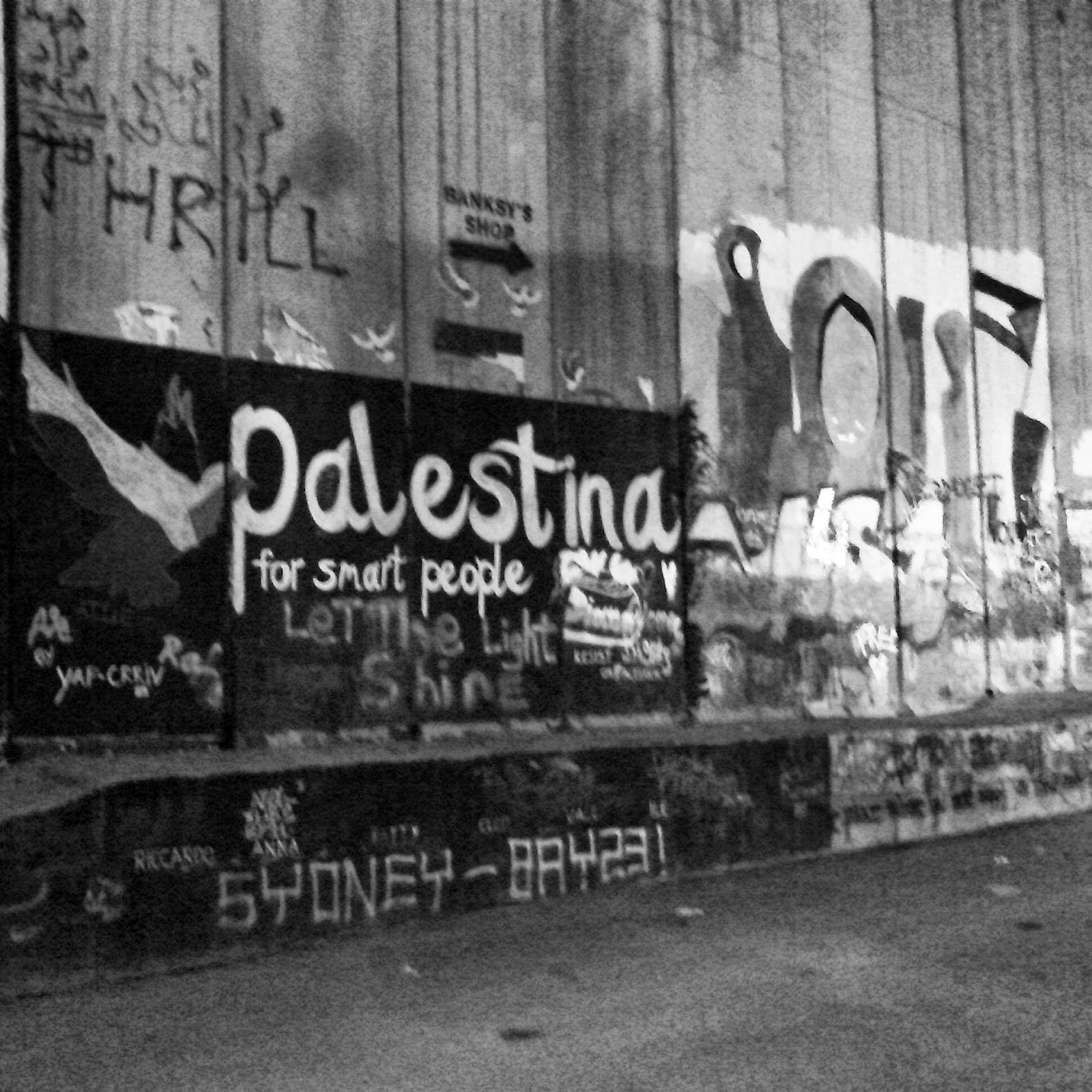
Ramallah is a very cosmopolitan city, with cafes, bars and restaurants and a wealth of internationals who work, volunteer or visit.  However, the apartheid wall which separates Israel from Palestine and is illegal under international law, is a cruel reminder that this is anything but a normal city for its inhabitants.


Crossing checkpoints can take hours and you never know how long Israeli soldiers will make you wait or why.  I've heard countless stories of women giving birth at checkpoints and others dying there, unable to pass even by ambulance.

Now I'm living in a refugee camp in Bethlehem supporting an artist who has a disability.  The camp has had soldiers raiding homes in the night twice since I arrived 2 days ago. This is life for Palestine's children. Yesterday we heard about an Arab bus driver who was beaten and hung by Israeli settlers, he was 32 years old and a father.  The news reported this as suicide.

Today, 4 Israelis have been killed in Jerusalem and it has been reported as 'the most deadly terror attack in 6 years.'

This year over 2000 Palestinians, including women, children and the elderly have been killed by the Israeli forces and settlers.  The violence committed against Palestinians happens every second they breathe with every house demolition, every soldier occupying heir land, every checkpoint, every blocking of food and medical supplies and every tear gas canister and bullet fired.

The prime minister Netanyahu has already promised a heavy handed response, which we know means the collective punishment of all Palestinians.